The "sad inevitability" of Europe's heat wave
The "sad inevitability" of Europe's heat wave
The climate has changed The sad inevitability of Europe s heat wave Europeans are baking under their second heat wave of the summer.
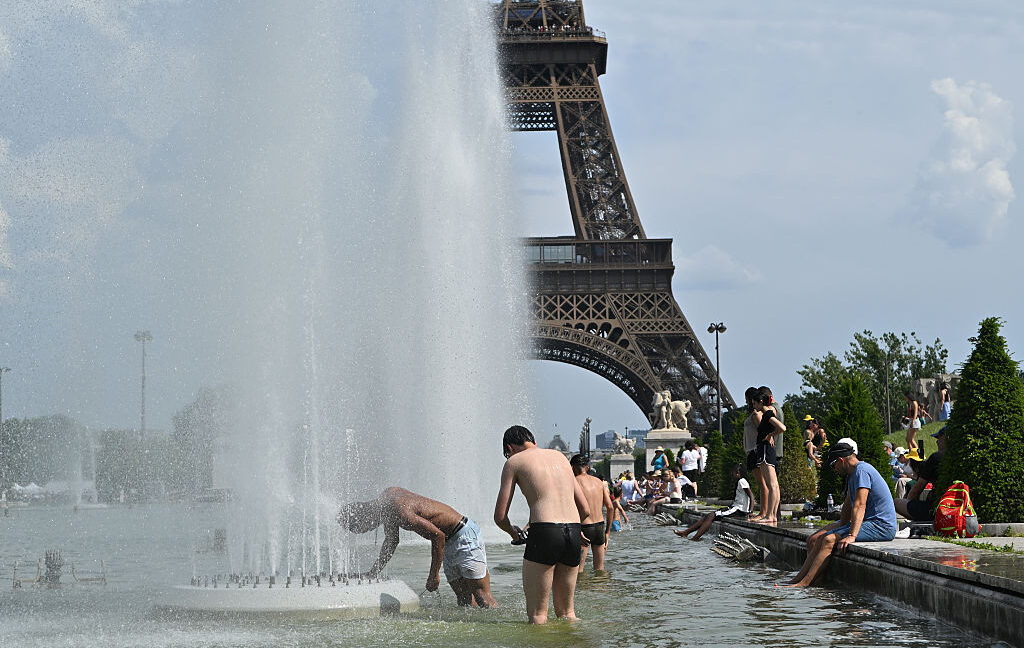
Lauren Dalban, Inside Climate News – Jun 25, 2026 9:54 am | 170 People cool off in the fountains of the Trocadero Gardens, with the Eiffel Tower in the background, in Paris on June 20, 2026.
Credit: Anadolu via Getty People cool off in the fountains of the Trocadero Gardens, with the Eiffel Tower in the background, in Paris on June 20, 2026.
Credit: Anadolu via Getty Text settings Story text Size Small Standard Large Width * Standard Wide Links Standard Orange * Subscribers only Learn more Minimize to nav Europe is in the midst of its second big heat wave of the year, and it’s breaking more records.
France just recorded its hottest day ever , with temperatures exceeding 44° Celsius in some places.
Around 40 people have drowned in local water bodies, likely attempting to escape the heat, and thousands more are without electricity.
As temperatures hit a sweltering 36° in some regions of the United Kingdom, schools canceled classes and train delays abounded.
United Nations Secretary-General Antonio Guterres described London as “cooking.
” As the city hosts its annual Climate Action Week, the UK meteorological service has issued a red alert for multiple regions, signaling that exceptionally hot and humid weather is forecasted and likely to impact the general public.
Switzerland and Spain have also issued warnings to residents.
Emma Howard Boyd, the former chair of the London Climate Resilience Review who now chairs the National Heat Risk Commission in the UK, said that when it comes to heat resilience in the country, the problem is not just homes—which are usually not air-conditioned.
“All of our infrastructure was built for a different type of climate,” she said.
Even seemingly small things, like malfunctioning elevators in tall buildings, could become lethal during a fire.
The London Climate Resilience Review found that 18 elevators in public housing blocks in a single city borough failed during the 2022 heat wave.
National policies to address the changing climate, she said, should also take into account those most vulnerable to heat stress, like children, the elderly, and pregnant women.
On Monday, two children died in a hot car in France.
Heat can adversely impact many different essential bodily functions, like sleeping and exercising.
For many climate scientists, the link between the frequency and duration of these heat waves and climate change cannot be overstated.
Some have even gone public with their dissatisfaction with the media coverage of the heat wave.
This past May, only 40 percent of British television and radio news stories about the heat wave linked it to climate change, according to Climate News Tracker.
“There’s a sad inevitability to all of this, with scientists like me trotting out the same quotes year after year,” Friederike Otto, a professor of climate science at the Imperial College London who leads the World Weather Attribution, a group that works to link weather events to climate change, said in an email.
“Simply put, we remain on a one-way trip towards a more dangerous future, and it’s time we hit the brakes.
” With the planet on track to exceed 1.
5° Celsius of human-induced warming, it is no surprise that extreme heat events increase in frequency, intensity, and duration, said Daniel Swain, a climate scientist at the California Institute for Water Resources at University of California, Los Angeles.
“A rising tide raises all boats,” he said.
Climate warming doesn’t just worsen heat waves by increasing temperatures by a few degrees.
For the most extreme events, scientists have found that a warmer climate can amplify meteorological feedback loops , further worsening heat waves and sometimes even leading to droughts.
In Western Europe, the incidence of a type of weather system called a blocking pattern—essentially an atmospheric traffic jam that can extend weather patterns—has increased, and scientists are currently researching the link between these patterns, human-induced global warming, and heat waves.
“Heat waves are going to keep getting hotter and more frequent until we reach net zero,” Helen Millman, a climate scientist and postdoctoral research fellow at the Global Systems Institute at University of Exeter, said in an email.
“While people worry about the upfront cost of decarbonising, that investment is tiny compared to what we will pay to constantly repair a country battered by a harsher climate.