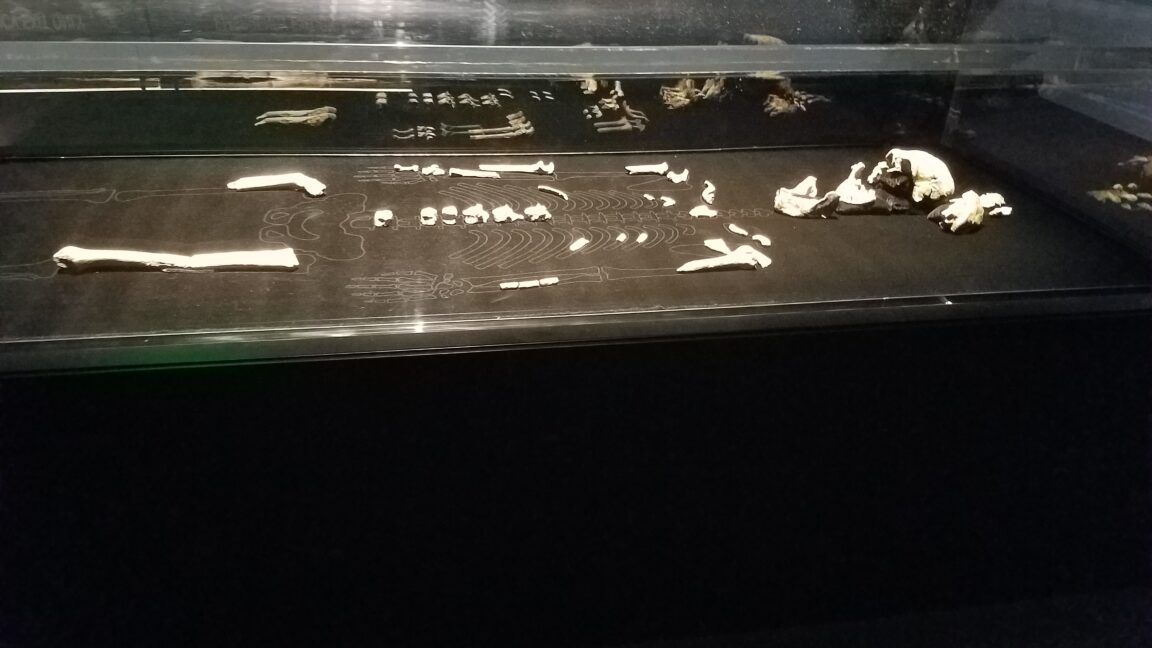
women in stem Every Homo naledi we know of is female, and the implications are fascinating There is no natural explanation, says paleoanthropologist John Hawks.
Smith – Jun 25, 2026 9:28 am | 68 Neo, the type specimen for Homo naledi, was originally thought to be male, but guess what? Credit: Kiona Smith Neo, the type specimen for Homo naledi, was originally thought to be male, but guess what? Credit: Kiona Smith Text settings Story text Size Small Standard Large Width * Standard Wide Links Standard Orange * Subscribers only Learn more Minimize to nav All the Homo naledi skeletons in Rising Star Cave are female, and that probably didn’t happen by accident.
In 2013, a team of anthropologists led by Lee Berger unearthed the remains of more than 20 small-bodied hominins (ancient relatives of humans), all 335,000 to 236,000 years old, from the Rising Star Cave System in South Africa.
Excavations at Rising Star have sparked debate about whether these little hominins had all ended up in the caves by tragic accident, or whether they’d been carefully placed there by other members of their enigmatic species, dubbed Homo naledi.
Now there’s a plot twist that may speak to how the remains got there: All of the hominins in Rising Star are female, at least according to the proteins in their dental enamel.
Little bits of teeth had a big surprise Max Planck Institute for Evolutionary Anthropology molecular scientist Palesa Madupe and her colleagues recently analyzed the proteins in dental enamel from 23 Homo naledi teeth unearthed in four different cave chambers deep in the Rising Star system.
Those 23 teeth came from at least 20 different individuals, ranging from babies with their first tiny teeth to older adults with teeth worn down from decades of chewing.
All of the samples contained a protein called amelogenin-X, or AMELX, which is encoded in the DNA of the X-chromosome.
But not a single sample contained the male version, AMELY, which is encoded on the Y-chromosome.
In genetically male humans, dental enamel usually contains about a tenth as much AMELY as AMELX, and Madupe and her colleagues say that given the level of AMELX in their samples, they should have been able to detect AMELY if it was there.
It appears that every single skeleton in the cave system, meaning every known Homo naledi (except the ones for whom the anthropologists found only bones, not teeth), is genetically female.
The odds of that being a coincidence are about the same as the odds of flipping a coin 20 times and landing on the same side every time: 0.
0000954 percent, according to Madupe and her colleagues.
In other words, the metaphorical coin must be weighted—in this case, by hominins doing things on purpose, like laying their dead to rest in the narrow, twisting darkness of Rising Star.
“This was no longer chance, at this point,” Berger (also a co-author of the recent study) tells Ars Technica.
Rising Star is a tomb It’s technically possible that the code for AMELY just got deleted from the DNA; that happens sometimes in humans, and it has happened in at least one Neanderthal.
But it’s extremely rare—so rare that it’s unlikely to explain what’s going on with Homo naledi.
It’s much more likely that the dead hominins in Rising Star actually are all genetically female.
It’s not unusual to find mostly female groups of primates in nature: Chimpanzees and gorillas both live in groups where nearly all of the adults are female.
Even so, the group inevitably includes children of both sexes.
But even the babies in Rising Star are all female.
“It is rarely the case that we have such clear evidence of culture as this case is,” University of Wisconsin paleoanthropologist John Hawks, another co-author of the recent study, tells Ars Technica.
“It’s like, there is no other process that can make this happen.
” It’s technically possible, perhaps, that Homo naledi divided up the work of hunting and gathering, or even some kind of ritual activity, in a way that meant females were the ones venturing deep into the cave and getting lost or trapped.
But if they took the children with them, then we should see males among the tiny skeletons that make up half the sample.
The most likely option now looks like Homo naledi buried its dead.
Berger and his colleagues have been arguing in favor of that point for years, but now there’s more: It also looks like Homo naledi , with its chimp-sized brain, even had a concept of gender as a part of an individual’s identity that mattered even in death.
Some aspects of this reconstruction will need updates.
Credit: Kiona Smith Some aspects of this reconstruction will need updates.
Credit: Kiona Smith What else do Homo naledi ’s proteins tell us? The protein analysis also offers some hope of answering one of the many lingering questions about Homo naledi : How are they related to us and the other members of the hominin family tree? The bones themselves offer more questions than answers.